I've been notified by a few people that have started to follow this blog, and as FYI to my new fans/readers that may not be in the know, I do gear reviews and some other writing for Performer Magazine. They can be found here:
http://performermag.com/
Thanks for reading!
Chris
Saturday, October 22, 2016

Sunday, October 9, 2016
"scarface" postscript/update!
If you read my previous post on my "scarface" partscaster, This is a neat update. Wampler Pedals (https://www.wamplerpedals.com) had a great post on their social media pages regarding a single coil (in this case a single coil humbucker) in the neck position. This isn't that far off on what I had in mind for my singer's guitar, that later on became my "scarface" partscaster. Glad to see someone followed through with that interesting concept. I just wonder how it actually sounds!


Friday, September 23, 2016
Say Hello To My Little Friend
A good guitar always has an interesting story
A very long time ago, I was in a band where the lead singer played rhythm guitar. He was no where near even a moderate gear head, a guitar to him was a tool. His guitar at the time was an Ibanez that had a H-S-H pickup configuration and a Floyd rose type of locking tremolo. For a guy that would use a guitar as a songwriting tool, I don't know how he ended up with it, probably some pressure from a sales clerk, I imagined. He was pretty heavy handed, and with a little suggestion he switched from .09 strings to .10's, to prevent string breakage. His picking hand kind of rested on the floating bridge, so at times, things got warbly out of tune here and there.
Floyd Roses bridges are great, and believe me, not all that long before that Ibanez style guitar would have been on my "must have" lists for guitars. But when you break a string, it's a few more steps to fix the situation. My singer, even with heavier strings, could really be tough on them. Compound that with a fairly heavy gig schedule, he was breaking enough strings that I bought a box of D'Addario's. With our heavy gigging schedule we went through them in less than a year.
I suggested I build him a guitar that would be more fitting to his style, not a shred machine, but truly a great rhythm guitar, that would stay in tune, be less prone to string breakage, and look interesting. He was all game, and while we were both pretty broke, I figured buying parts from craigslist and ebay would cut the costs alot, and final assembly would be the biggest expense overall.
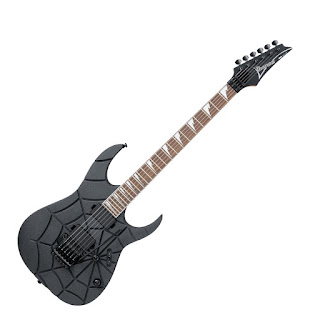
I started with a standard strat style body, it was pretty heavy, so I assumed it was ash. It was already finished in gloss black, with some dings in it. For $25 it was a great EBay find. Sanding down the electronics cavity I realized it was solid wood, not a plywood body. I scuffed the gloss black to a satin appearance, to make it look a bit rat-rod ish. Taking my Dremel fitted with a conical grinding bit, I started to carve scar or vein like grooves into the body. I made sure that they would begin or end at the edge of the pick guard. After I filled these exposed veins with flat black modeling paint, it had a rough rugged look to it. My next idea was to get ultra violet paint (the kind that only appears under black lights) and then go over the grooved areas again with that. We played a few clubs where the sound guy ran the lights, and for some reason they had a "black light" mode in their lighting rigs. the final touch would be getting a glitter-ish paint, where a small amount of glitter or metal flake was suspended in a clearcoat, and then go over the UV paint with that, I got the idea of from one of the bartenders at one of those clubs. Her lipstick lit up in the black light, unbeknownst to her, and she always had some of that heavy glitter that she applied over her lipstick. My singer loved the idea. There were some Ibanez guitars that had a carved in to the body Spider web style, and this was a bit more organic like feel to that same concept.
Electronics wise, My idea was a single humbucker in the neck. Even in the studio when a producer or engineer heard his guitar they would ask why his sound was so bass heavy. He always played on the neck pickup for it's fuller sound. They would always get him to switch to the bridge pickup in the studio. During sessions he'd switch it back, either intentionally or accidentally with his strumming. During mixes they'd be scratching their heads, trying to clean up his sound. Eventually they would give up, in more than one case the engineer would confide in me that he was glad I did so many guitar tracks; if we were playing the same kind of guitar part, they just mixed our singer's rhythm guitar out. When his parts were front and center, they fixed them, they did their best to make it sound good.
A single humbucker wouldn't have alot of tonal options, but I figured getting a 3 way toggle; with the 1st position, just the front coil, the 2nd a full humbucker, and the 3rd, the rear coil. Again, thankfully our singer didn't really think of this as odd. The only other control would be a volume knob. It made for a simple instrument. It still had some tonal options, albeit limited to rhythm sounds.
Since our singer had kind of big hands, he liked the Ibanez slim line neck, but it seemed he pulled too hard on it, and would slide strings almost off the fretboard. I was hoping a rounder neck would be a better fit. I went on a search for a fairly large radius neck. Again, on Ebay I found one, it had no logos or any markings, but based on the headstock shape it was either a Peavey, or an allparts item. The rosewood fingerboard was nice, and all the frets were in good shape. For another $25 it was a deal. I primed the headstock, and painted it flat black to match the guitar body.
The body was routed for a standard strat style tremolo, so I was limited in choices there. Ideally I wanted to find one with roller saddles, but no luck. Ebay again provided a chrome bridge, with heavy block saddles by WD, still in the box, for $35.
I was only into the guitar for $85 or so, when I showed my singer the body, and he was excited to see it, as well as the neck, He gave his approval of the progress thankfully. A few weeks later on I said if he could throw me a couple of bucks, I could finish off this guitar for him.
Admittedly, we were all broke, but at this point my singer said "I never said I wanted you to build me a guitar" I don't know if it was a money issue, or something else. I kind of assumed after talking about it, it was a go. After showing him the body and parts he was excited, so again, I though he wanted me to do this. But when it came time to put in some money on his end, not only was I vetoed, I was told it was never approved. Maybe I misunderstood. Regardless I now had a project guitar in the works, and not alot of money to finish it off.
I thought of selling the neck and bridge, I could re-coup some of that. The body was now all caved up, and in complete flat black. I doubt that would have sold at all. I decided this would be a long term project for me. If I completed it, I'd make it a guitar for me. If my singer wanted it afterwards, I'd sell it to him for cost, plus assembly.
Eventually I left that band. One night under the influence of some good beer I hung the guitar up, and grabbed a few cans of spray paint I had. My MGB was in the middle of restoration, and I had a good selection of various paints for all the parts I was doing for it. Silver, a red with a metallic in it, as well as a black with a slight metal flake, I'd drink a bit, spray a bit, let it dry, and then repeat the process. by the end of the night, It looked cool. With all the grooves and scars, it kind of got to be known as "scarface"
Sound wise I wasn't going to do a single neck pickup anymore. The electronics 2 humbuckers from a PRS SE Tremonti, mounted on a single ply black pickguard. I did a single volume knob, and a three way switch. To finish things off, I got a set of used G&L Tuners from my local music store for about $35. After finally getting it together, it played pretty nice. The pickups weren't my fave though. They lacked a bit of bottom end. Im sure in the PRS the were designed for they would be ok, but not this parts caster. It kind of got stuck in that mode and I forgot about it. Eventually I replaced the pickguard with a single HB and volume knob, and went with a guitarfetish VEH pickup, which is kind of like a Van-halen ish humucker. I've hand some other pickups from guitarfetish, and I have to say it's a your mileage may vary. The hum cancelling single coils in my tele, are just Ok. This humbucker is really nice tho!
With the single humbucker, the guitar actually came to life. It has alot of punch, clarity, low end and overall sounds great. For a single pickup guitar there's still plenty of tones in there. The neck is a bit fatter than what I usually play, but it does feel great. Unplugged it's fairly bright, with plenty of snap. I blocked the Tremolo, and it adds a lil more sustain, but stays in tune really well. It's a bit heavy, bit that's the only downside.
It's my go to "around the house" guitar. It's great for just running to the computer and doing a demo, super easy to dial in a tone and just go. At the time I felt kind of let down when my singer pulled the plug on doing it, I really think it would have been a good guitar for him, but I ended up with a great inexpensive guitar.

A very long time ago, I was in a band where the lead singer played rhythm guitar. He was no where near even a moderate gear head, a guitar to him was a tool. His guitar at the time was an Ibanez that had a H-S-H pickup configuration and a Floyd rose type of locking tremolo. For a guy that would use a guitar as a songwriting tool, I don't know how he ended up with it, probably some pressure from a sales clerk, I imagined. He was pretty heavy handed, and with a little suggestion he switched from .09 strings to .10's, to prevent string breakage. His picking hand kind of rested on the floating bridge, so at times, things got warbly out of tune here and there.
Floyd Roses bridges are great, and believe me, not all that long before that Ibanez style guitar would have been on my "must have" lists for guitars. But when you break a string, it's a few more steps to fix the situation. My singer, even with heavier strings, could really be tough on them. Compound that with a fairly heavy gig schedule, he was breaking enough strings that I bought a box of D'Addario's. With our heavy gigging schedule we went through them in less than a year.
I suggested I build him a guitar that would be more fitting to his style, not a shred machine, but truly a great rhythm guitar, that would stay in tune, be less prone to string breakage, and look interesting. He was all game, and while we were both pretty broke, I figured buying parts from craigslist and ebay would cut the costs alot, and final assembly would be the biggest expense overall.
I started with a standard strat style body, it was pretty heavy, so I assumed it was ash. It was already finished in gloss black, with some dings in it. For $25 it was a great EBay find. Sanding down the electronics cavity I realized it was solid wood, not a plywood body. I scuffed the gloss black to a satin appearance, to make it look a bit rat-rod ish. Taking my Dremel fitted with a conical grinding bit, I started to carve scar or vein like grooves into the body. I made sure that they would begin or end at the edge of the pick guard. After I filled these exposed veins with flat black modeling paint, it had a rough rugged look to it. My next idea was to get ultra violet paint (the kind that only appears under black lights) and then go over the grooved areas again with that. We played a few clubs where the sound guy ran the lights, and for some reason they had a "black light" mode in their lighting rigs. the final touch would be getting a glitter-ish paint, where a small amount of glitter or metal flake was suspended in a clearcoat, and then go over the UV paint with that, I got the idea of from one of the bartenders at one of those clubs. Her lipstick lit up in the black light, unbeknownst to her, and she always had some of that heavy glitter that she applied over her lipstick. My singer loved the idea. There were some Ibanez guitars that had a carved in to the body Spider web style, and this was a bit more organic like feel to that same concept.

Electronics wise, My idea was a single humbucker in the neck. Even in the studio when a producer or engineer heard his guitar they would ask why his sound was so bass heavy. He always played on the neck pickup for it's fuller sound. They would always get him to switch to the bridge pickup in the studio. During sessions he'd switch it back, either intentionally or accidentally with his strumming. During mixes they'd be scratching their heads, trying to clean up his sound. Eventually they would give up, in more than one case the engineer would confide in me that he was glad I did so many guitar tracks; if we were playing the same kind of guitar part, they just mixed our singer's rhythm guitar out. When his parts were front and center, they fixed them, they did their best to make it sound good.
A single humbucker wouldn't have alot of tonal options, but I figured getting a 3 way toggle; with the 1st position, just the front coil, the 2nd a full humbucker, and the 3rd, the rear coil. Again, thankfully our singer didn't really think of this as odd. The only other control would be a volume knob. It made for a simple instrument. It still had some tonal options, albeit limited to rhythm sounds.
Since our singer had kind of big hands, he liked the Ibanez slim line neck, but it seemed he pulled too hard on it, and would slide strings almost off the fretboard. I was hoping a rounder neck would be a better fit. I went on a search for a fairly large radius neck. Again, on Ebay I found one, it had no logos or any markings, but based on the headstock shape it was either a Peavey, or an allparts item. The rosewood fingerboard was nice, and all the frets were in good shape. For another $25 it was a deal. I primed the headstock, and painted it flat black to match the guitar body.
The body was routed for a standard strat style tremolo, so I was limited in choices there. Ideally I wanted to find one with roller saddles, but no luck. Ebay again provided a chrome bridge, with heavy block saddles by WD, still in the box, for $35.
I was only into the guitar for $85 or so, when I showed my singer the body, and he was excited to see it, as well as the neck, He gave his approval of the progress thankfully. A few weeks later on I said if he could throw me a couple of bucks, I could finish off this guitar for him.
Admittedly, we were all broke, but at this point my singer said "I never said I wanted you to build me a guitar" I don't know if it was a money issue, or something else. I kind of assumed after talking about it, it was a go. After showing him the body and parts he was excited, so again, I though he wanted me to do this. But when it came time to put in some money on his end, not only was I vetoed, I was told it was never approved. Maybe I misunderstood. Regardless I now had a project guitar in the works, and not alot of money to finish it off.
I thought of selling the neck and bridge, I could re-coup some of that. The body was now all caved up, and in complete flat black. I doubt that would have sold at all. I decided this would be a long term project for me. If I completed it, I'd make it a guitar for me. If my singer wanted it afterwards, I'd sell it to him for cost, plus assembly.
Eventually I left that band. One night under the influence of some good beer I hung the guitar up, and grabbed a few cans of spray paint I had. My MGB was in the middle of restoration, and I had a good selection of various paints for all the parts I was doing for it. Silver, a red with a metallic in it, as well as a black with a slight metal flake, I'd drink a bit, spray a bit, let it dry, and then repeat the process. by the end of the night, It looked cool. With all the grooves and scars, it kind of got to be known as "scarface"
Sound wise I wasn't going to do a single neck pickup anymore. The electronics 2 humbuckers from a PRS SE Tremonti, mounted on a single ply black pickguard. I did a single volume knob, and a three way switch. To finish things off, I got a set of used G&L Tuners from my local music store for about $35. After finally getting it together, it played pretty nice. The pickups weren't my fave though. They lacked a bit of bottom end. Im sure in the PRS the were designed for they would be ok, but not this parts caster. It kind of got stuck in that mode and I forgot about it. Eventually I replaced the pickguard with a single HB and volume knob, and went with a guitarfetish VEH pickup, which is kind of like a Van-halen ish humucker. I've hand some other pickups from guitarfetish, and I have to say it's a your mileage may vary. The hum cancelling single coils in my tele, are just Ok. This humbucker is really nice tho!
With the single humbucker, the guitar actually came to life. It has alot of punch, clarity, low end and overall sounds great. For a single pickup guitar there's still plenty of tones in there. The neck is a bit fatter than what I usually play, but it does feel great. Unplugged it's fairly bright, with plenty of snap. I blocked the Tremolo, and it adds a lil more sustain, but stays in tune really well. It's a bit heavy, bit that's the only downside.
It's my go to "around the house" guitar. It's great for just running to the computer and doing a demo, super easy to dial in a tone and just go. At the time I felt kind of let down when my singer pulled the plug on doing it, I really think it would have been a good guitar for him, but I ended up with a great inexpensive guitar.

Tuesday, August 30, 2016
Low End Problems
I’ll be honest I’m kind of a frustrated bass player in a certain sense. Back in the jr high school years, when I was getting into music, I toyed with the idea of playing Bass. Part of the reason I didn’t, was that several musicians I really respected played bass, and if I became a bass player myself, there were a few negatives. 1-I would probably never be able to play or collaborate with them, as we both shared the same instrument. 2. In the typical razzing you get in the early teen years the “oh you’re doing it so you can be like so-and-so. 3. Bass strings were a lot more expensive than guitar strings 4. The general thought was if you’re going to be a good bass player, you’re going to have to read sheet music.
So I ended up playing guitar.
In the past whenever I was working on demos at home I’d borrow a bass from someone, and always feel in some way that this feels right, even when I ended up with callouses and blisters. Eventually I got my own bass, and again I like using it for demos, but it doesn’t get a lot of use other than that. Thankfully I didn’t pay that much for it.
I’ve messed around with some nonstandard tunings, like Drop D, and even at one point had my strat set up a whole step lower. To take things even further I took an inexpensive first act guitar and even had it set up in a baritone tuning with heavier strings. It was a fun experiment, but had issues; while tuned low, things got flubby, more than likely due to the fact that the scale was a standard guitar scale. The longer scale of a baritone would bring that tight crispness to that big low end.
A few years back Epiphone sent me a Rob Flynn Flying V baritone to review. It was a fun guitar, and definitely showed the actual difference the long scale made. However, personally, the skull graphics on a flying V body wasn’t really my thing aesthetically.
I did get a few chances over the years to play a few baritones, A Jerry Jones, fender bass VI, a Telecaster conversion, an Ibanez Mike Mushok, as well as a few custom pieces. While I liked Epiphone’s forward thinking the others were in most cases (the Ibanez being the exception) a bit too vintage sounding. I was looking for something “in-Between”.
The Ibanez Mike Mushok was cool, and after I tried it out, I put it back on the wall at the store. Going back to the same store a few weeks later, I told myself, “If it’s there, just buy it”. I figured it’s a niche instrument, and would probably gather dust, until some sale event. Boy was I wrong. Cruzing the wall, it was nowhere to be found. I asked the guy behind the counter who told me I was the 3rd guy to ask about it that week! Apparently it was sold a day or two after I tried it out.
So then PRS made a Baritone, and again this was Mike Mushok’s signature edition. At $699 the price was OK, and came in an Adam Jones inspired silver burst, and later versions came in a nice classy vintage see thru look. My main guitars are by PRS, and as I know their quality, tone and feel. I’d love to “keep it in the family” so to speak. As I got ready to pull the trigger (meaning I had some spare $) it was gone off of PRS’ website, as it was discontinued. Alas, looking for a used one for a reasonable price on craigslist was also difficult.
Fast forward to 2016, PRS now offers TWO baritones, a humbucker equipped one, and a semi hollow p90 one. I’ve made it my personal mission to save up enough for one by the end of this year. However I am in a quandary, as I love the P90 version (it comes in a cool grey/black see thru finish) the noise of the P90’s may require some pickup upgrade, where the humbucker version might not.


The application of this instrument might be a bit different, in some cases I’ve thought of getting together with a bass player, preferably a 5 string player and a drummer, or even just a keyboard player and a drummer for some morphine-ish type stuff. It seems like an interesting new creative tool that I’d like to check out.
I’d love to hear from any baritone players and their experiences with this type of guitar, in their application of using it in a band, as well as any special gear that has helped them integrate such an odd and interesting instrument.
So I ended up playing guitar.
In the past whenever I was working on demos at home I’d borrow a bass from someone, and always feel in some way that this feels right, even when I ended up with callouses and blisters. Eventually I got my own bass, and again I like using it for demos, but it doesn’t get a lot of use other than that. Thankfully I didn’t pay that much for it.
I’ve messed around with some nonstandard tunings, like Drop D, and even at one point had my strat set up a whole step lower. To take things even further I took an inexpensive first act guitar and even had it set up in a baritone tuning with heavier strings. It was a fun experiment, but had issues; while tuned low, things got flubby, more than likely due to the fact that the scale was a standard guitar scale. The longer scale of a baritone would bring that tight crispness to that big low end.
A few years back Epiphone sent me a Rob Flynn Flying V baritone to review. It was a fun guitar, and definitely showed the actual difference the long scale made. However, personally, the skull graphics on a flying V body wasn’t really my thing aesthetically.
I did get a few chances over the years to play a few baritones, A Jerry Jones, fender bass VI, a Telecaster conversion, an Ibanez Mike Mushok, as well as a few custom pieces. While I liked Epiphone’s forward thinking the others were in most cases (the Ibanez being the exception) a bit too vintage sounding. I was looking for something “in-Between”.
The Ibanez Mike Mushok was cool, and after I tried it out, I put it back on the wall at the store. Going back to the same store a few weeks later, I told myself, “If it’s there, just buy it”. I figured it’s a niche instrument, and would probably gather dust, until some sale event. Boy was I wrong. Cruzing the wall, it was nowhere to be found. I asked the guy behind the counter who told me I was the 3rd guy to ask about it that week! Apparently it was sold a day or two after I tried it out.
So then PRS made a Baritone, and again this was Mike Mushok’s signature edition. At $699 the price was OK, and came in an Adam Jones inspired silver burst, and later versions came in a nice classy vintage see thru look. My main guitars are by PRS, and as I know their quality, tone and feel. I’d love to “keep it in the family” so to speak. As I got ready to pull the trigger (meaning I had some spare $) it was gone off of PRS’ website, as it was discontinued. Alas, looking for a used one for a reasonable price on craigslist was also difficult.
Fast forward to 2016, PRS now offers TWO baritones, a humbucker equipped one, and a semi hollow p90 one. I’ve made it my personal mission to save up enough for one by the end of this year. However I am in a quandary, as I love the P90 version (it comes in a cool grey/black see thru finish) the noise of the P90’s may require some pickup upgrade, where the humbucker version might not.


The other issue is finding a cabinet that can handle those low notes. I have blown out a few 12” speakers even just with low tunings. I’m thinking of a 1x15 cabinet to take care of those low frequencies. I’d probably run one of my regular amp’s into it, like my ZT for any loud volume situations. I have a great hotone amp that could handle quitter gigs. Thankfully both are small amps
The application of this instrument might be a bit different, in some cases I’ve thought of getting together with a bass player, preferably a 5 string player and a drummer, or even just a keyboard player and a drummer for some morphine-ish type stuff. It seems like an interesting new creative tool that I’d like to check out.
I’d love to hear from any baritone players and their experiences with this type of guitar, in their application of using it in a band, as well as any special gear that has helped them integrate such an odd and interesting instrument.
Monday, August 1, 2016
Sharing is Good
I figured I'd share some of my music with you all. This is an acoustic track, That has some acoustic 6 and 12 string guitars, as well as some guitar synth for some ambience. It's not my usual thing, but I hope you like:
Thursday, July 21, 2016
Contests and Giveaways
Sorry, I don’t have anything to give away here. But “winning” is always on everyone’s mind: the lottery, or at a casino, a sporting event, or an election. Guitar magazines/companies/websites often do giveaways: enter your name to win. More often than not it’s a way for companies to get some demographic info on you for marketing, or even just your email for future notices/spam. Thankfully most email giveaways don’t encourage spam, or unwanted emails.
I remember entering in every giveaway that was ever offered since I got my first guitar magazine. I’ve never won anything. Thinking of all those 3x5 cards that usually fell out of a magazine, getting them filled out, and into the mail. When the internet came into play, all the web pages with a click here to win button. Yet always a bridesmaid, never a bride.
Even now so many years later I still do it, getting extra entries for sharing with Facebook or twitter, even the Instagram ones where you have to capture and repost an image, which is kind of a pain in the butt. All in hopes for a win. A free guitar is a great guitar.
So in the spirit of winning, I’ll share with you a giveaway, it’s from John Mann’s Guitar vault. Every year he goes to the PRS factory, picks out some amazing wood, and sometime later a beautiful guitar emerges. He the offers it up in a raffle, for $103 a chance to win, and there is a limited number of tickets sold. The money raised goes to the Daniel Webster house, a charity for homeless teens in NH. A good cause, and a great guitar.
Even If I don’t win, I know it’s going to a good cause. Just on a probability scale though, eventually I’m bound to win something one day. Finger’s crossed.
If you want to win, here's a link HERE
Sunday, July 17, 2016
Not Abandoned..yet
Blogs tend to get created with enthusiasm, kept up for a bit, then forgotten and discarded. I hate to say it, but this was one of those.
In the past 5 years, I've been busy: Getting married, writing for Performer Magazine, where I am now Senior Product Reviewer, working with my band "The Goodbye Theory", and dealing with the general stuff that life throws your way.
I'm making a effort to bring this Blog back to life. In the future I'll have links to my articles for Performer Magazine, Pictures, videos, Audio, and other writing musings related to Guitar and music in general. I'm going to try to have some new content a couple of times a week, hopefully it'll be something to keep you all coming back!
Enjoy
Christopher Devine
In the past 5 years, I've been busy: Getting married, writing for Performer Magazine, where I am now Senior Product Reviewer, working with my band "The Goodbye Theory", and dealing with the general stuff that life throws your way.
I'm making a effort to bring this Blog back to life. In the future I'll have links to my articles for Performer Magazine, Pictures, videos, Audio, and other writing musings related to Guitar and music in general. I'm going to try to have some new content a couple of times a week, hopefully it'll be something to keep you all coming back!
Enjoy
Christopher Devine
Subscribe to:
Posts (Atom)